

How to Choose a Vending Service in Texas: A Practical Guide for Offices, Warehouses & Facilities Statewide
A step-by-step checklist covering service models, contracts, equipment, and red flags for offices, warehouses, and facilities across Texas.
Choosing the wrong vending service in texas costs more than a bad snack selection it means empty machines, frustrated employees, and a contract you can’t easily exit. With dozens of operators competing across the state, from single-city specialists to national chains, picking the right partner takes more than a Google search.
This guide breaks down exactly what to evaluate before you sign anything service models, equipment, contracts, and the red flags that separate a reliable Texas vending service from one that will leave your break room empty by Friday. Whether you manage an office in Dallas, a warehouse in Houston, or a campus in Austin, the same framework applies statewide.
1. Understand the Service Models Available in Texas
Before comparing vendors, understand what you’re actually buying. Most vending service Texas providers operate under one of three models, and each shifts cost and control in a different direction.
Zero-Cost / Fully Managed Vending
The operator owns the equipment, handles installation, stocks the machines, and covers maintenance at no upfront cost to your location. Many providers also offer a revenue share on sales. This model works well for offices, warehouses, hospitals, and gyms that want the amenity without a capital outlay or an internal team to manage it.
This is the model most Texas businesses default to, and for good reason it removes both the upfront equipment cost and the ongoing operational headache of restocking and repairs. The tradeoff is less direct control over product selection, though a good vendor will still take your input seriously.
If your office qualifies, this is essentially how you get a free vending machine setup in Texas without any upfront investment.
Lease / Rental Model
Your location leases or rents the equipment and takes on some or all of the product sourcing, either independently or through the vendor. This suits larger facilities that want more control over product selection and already have staff capacity to manage restocking oversight.
Purchase & Self-Operate
You buy the machines outright and manage everything in-house. This gives you full control, but it also means you own every maintenance call, restocking run, and compliance requirement. It rarely makes sense unless vending is a core part of your business.
Most offices and facilities across Texas choose the zero-cost model specifically because it removes operational burden see our vending machine options or micro market setup for a closer look at what’s included.
The mistake we see most often is a facility manager comparing quotes without first deciding which model they actually want. A zero-cost quote and a lease quote aren’t comparable numbers one includes labor and maintenance, the other doesn’t. Pin down the model first, then compare providers within that model.
2. Local Texas Presence With Statewide Coverage
One of the biggest mistakes facility managers make is assuming “bigger” means “better.” A national vending company routes your service call through a dispatch center. A single-city local operator might know your neighborhood but can’t support a company with locations in three different Texas metros.
Response Time & On-Ground Support
Local technicians can reach a broken machine same-day. National providers often route through call centers, adding a day or two before anyone shows up. If your break room amenity sits empty for 72 hours, employees notice and complain.
This gap widens further for facilities outside major metros. A national provider’s nearest technician might be an hour or more away, while a Texas-focused operator typically has coverage closer to smaller cities and suburbs across the state.
Product Selection That Fits Texas
Regional taste matters more than most vendors admit. A provider with real Texas market experience stocks what local employees actually buy spicier snacks, regional beverage brands, and seasonal rotations instead of running a generic national playbook.
Accountability & Relationship
A vendor whose reputation lives and dies in the same state you operate in has more reason to get restocking and repairs right. Ask for references from other Texas locations similar to yours and actually call them.
Reference checks are easier with a Texas-focused provider too. You can visit another location in your own metro area, see the machines in person, and talk to another facility manager facing the same regional challenges humidity, delivery logistics, or seasonal demand swings instead of comparing notes with someone in a different state.
We’ve seen offices switch providers within 48 hours because a national vendor took three days to repair a broken machine. That kind of delay is avoidable when the technician servicing your account also covers three other buildings in the same city.
A provider with both local responsiveness and coverage across Dallas, Houston, Austin, Fort Worth, Arlington, and Plano gives you the best of both you’re never stuck choosing between fast service and multi-location consistency. This matters most for companies with more than one Texas office, since it means one contract and one point of contact instead of juggling separate vendors per city.
If your business is specifically in the Dallas–Fort Worth metro, DFW Vending is a good example of a locally focused operator worth comparing against statewide providers.”
3. Equipment & Technology: What to Look For
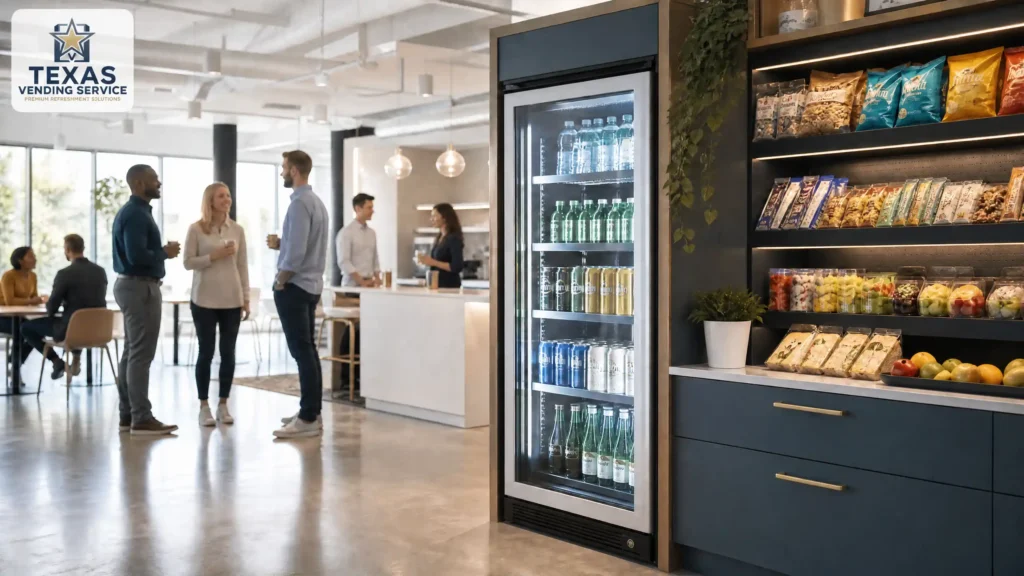
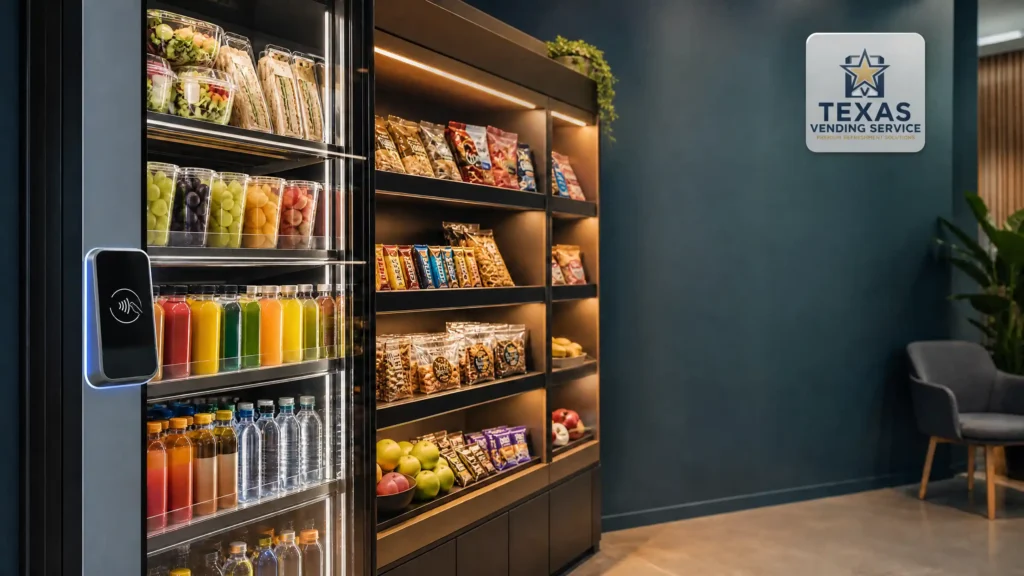
The hardware behind your vending service determines both employee satisfaction and how much of the operational burden falls on you.
Cashless & Contactless Payments
Credit and debit cards, Apple Pay, Google Pay, and tap-to-pay are now baseline expectations, not upgrades. Cash-only machines see lower sales and more employee complaints. Confirm this is standard, not an add-on fee, before you sign see how it works on our vending technology page.
Remote Monitoring & Telemetry
Machines with real-time inventory tracking flag low stock automatically, which means your provider restocks based on actual data instead of a fixed schedule that might miss a high-traffic week.This is one of several benefits of smart vending machines over traditional setups — see the full breakdown if you want to compare before deciding.
This matters most during unpredictable demand spikes a company event, a busy quarter-end, or an unusually hot week that drives up beverage sales. Telemetry catches that shift immediately; a fixed weekly restock schedule doesn’t.
Machine Types: Traditional Vending, Smart Coolers, Micro Markets
Traditional vending machines suit high-traffic areas with limited space, and remain the simplest option for snacks and beverages in a smaller break room. Smart coolers fit smaller footprints and work well for fresh food in offices or medical waiting rooms, since they combine grab-and-go convenience with refrigerated freshness. For a closer look at how this technology works in practice, DFW Markets’ AI Smart Cooler setup shows the same telemetry-driven approach in a live DFW location. Micro markets make sense for larger break rooms and apartment communities where higher revenue per location justifies the bigger setup think open shelving, a self-checkout kiosk, and a wider product range than any single machine could hold.
Choosing the wrong format is one of the most common and most avoidable mistakes. A 15-person office rarely needs a full micro market, and a 300-person warehouse will outgrow a single vending machine within weeks. Match the format to your headcount and foot traffic, not to what looks impressive during a sales pitch.
| Location Type | Recommended Format |
|---|---|
Small office (10–30 employees) | Smart cooler or 1–2 vending machines |
Medium office (30–100 employees) | 2–4 machines plus coffee service |
Large office or warehouse (100+ employees) | Micro market or multiple machines plus pantry service |
4. Product Selection & Customization
Your vendor’s product mix should reflect your workforce, not a one-size-fits-all catalog.
Snack & Beverage Variety
Look for a range that spans budget-friendly staples (chips, candy, soda) and premium options (energy drinks, specialty snacks) so every employee finds something they’ll actually buy.
Healthy & Fresh Food Options
Protein bars, nuts, baked snacks, and fresh sandwiches or salads matter most for wellness-focused offices, gyms, and hospitals. Check our healthy vending options if this is a priority for your location.
Employee wellness programs increasingly expect this from a workplace amenity, not just a food option. If your company already invests in wellness initiatives, a vending provider without a genuine healthy selection undermines that effort rather than supporting it.
Customization Based on Employee Feedback
A vendor should adjust the product mix based on what’s selling and what isn’t, and rotate seasonally more cold drinks in summer, more hot beverages in winter. Before signing, ask how often they collect feedback and how quickly they swap out underperforming items.
The most common complaint we hear about vending services isn’t price it’s a stale product mix that never changes. A provider using real sales data to rotate inventory avoids that problem automatically, while one running a fixed, generic planogram usually needs constant manual requests just to keep the machine relevant to your team.
5. Service, Restocking & Maintenance
This is where most vending relationships actually succeed or fail not at the sales pitch stage.
Restocking Frequency & Triggers
Ask whether restocking runs on a fixed schedule or is triggered by real inventory data. Data-driven restocking prevents the empty-machine problem that fixed schedules often miss during busy weeks.
Maintenance & Repair Response Time
Get a specific number same-day, next-day, or 48 hours and ask whether after-hours emergency support exists. “We’ll get to it soon” is not an answer you should accept.
Who Handles What?
Confirm who’s responsible for installation, restocking, cleaning, and repairs, and how much falls on your internal team. Our health and safety standards outline what a fully managed service should cover.
Get this in writing rather than assumed. Facility managers often discover mid-contract that machine cleaning wasn’t part of the agreement, or that reporting a jam requires calling a number nobody remembered to save. A clear division of responsibility upfront avoids that confusion entirely.
If a vendor says “we restock regularly” without naming a schedule or mentioning telemetry, that vagueness is itself a warning sign worth pressing on.
Ask what happens outside normal business hours, too. A warehouse running night shifts or a hospital operating around the clock needs a provider comfortable servicing machines at 2 a.m., not just during a standard nine-to-five window.
6. Contract Terms, Costs & Flexibility
Cost structure and contract terms determine how much flexibility you keep if the relationship doesn’t work out.
Contract Length & Exit Terms
Month-to-month agreements offer more flexibility than 1–3 year contracts. Whatever term you choose, confirm the early termination clause and whether any performance guarantees exist.
Cost Structure
Understand the difference between zero-cost placement, lease, and purchase pricing, and clarify product pricing, any profit sharing, and service fees upfront not after the first invoice.
Ask for a sample invoice or pricing sheet before signing. It’s the fastest way to catch hidden fees restocking surcharges, machine rental costs disguised as “service fees,” or pricing that increases after an introductory period.
Minimum Requirements
Some providers set minimums on employee count, foot traffic, or sales volume. If you run a smaller office, ask directly whether a provider works with businesses your size many quietly turn away accounts under a certain headcount without saying so upfront.
Also clarify who bears the cost if sales fall below expectations. A well-structured contract protects both sides, but a poorly written one can leave you paying a minimum fee for a machine nobody uses.
The Right Setup for a Small Business in Texas
A vending service for small business Texas locations doesn’t need the same scale as a 500-person corporate campus. Look for a provider willing to start with a single smart cooler or compact vending unit, with no long-term commitment required to prove the amenity works before you scale up. See how this applies to smaller office locations.
Small businesses often assume vending services are only worth pursuing at scale, which isn’t accurate. A 15-person office can qualify for a fully managed zero-cost setup just as easily as a 200-person warehouse — the main difference is machine count, not eligibility. Don’t let a provider’s minimum-size assumptions talk you out of an amenity your team would genuinely use.
7. Reputation, References & Compliance
Reviews, Testimonials & Case Studies
Check Google reviews and BBB ratings, and ask for case studies from businesses similar to yours office, warehouse, gym, or hospital.
Insurance & Compliance in Texas
Confirm the provider carries commercial liability insurance and can list your business as an additional insured. Ask about food handling compliance and health standards our health and safety page covers what to expect from a properly compliant vendor.
Site Visits & Demo Locations
A confident vendor will show you an existing location. Look at machine condition, cleanliness, and product freshness before committing anywhere.
Pay attention to how the vendor talks about past issues, not just successes. A provider that openly explains how they resolved a restocking problem or equipment failure at another Texas location tells you more about their reliability than a polished sales deck ever will. Vendors with nothing to hide tend to be the most transparent about what’s gone wrong before and how they fixed it.
If a provider serves multiple industries offices, hospitals, university campuses, or warehouses that breadth usually signals operational maturity. A vendor that has only ever serviced one type of location may not have the systems in place to handle your facility’s specific traffic patterns or compliance needs.
8. Red Flags to Avoid When Choosing a Vending Partner
Most vending contracts that go wrong show warning signs early during the sales conversation, not after the machines are installed. Watch for these before you sign anything:
- Vague restocking commitments like "we come by regularly" with no specific schedule
- No mention of remote monitoring or inventory telemetry
- Pressure to sign a long-term contract with no performance guarantees
- Slow response to equipment issues anything beyond 24–48 hours
- No clear point of contact, only a general 1-800 number
- Equipment that looks outdated or poorly maintained during a site visit
- Unwillingness to provide references or show an existing location
Any one of these alone isn’t necessarily disqualifying, but two or more together usually point to a provider that will cost you more time than it saves.
9. Key Questions to Ask Any Texas Vending Provider
Who owns the equipment, and what happens if we end the agreement?Who owns the equipment, and what happens if we end the agreement?
In most fully managed deals, the vendor owns the equipment and removes it at no cost when the contract ends. Get this in writing before you sign.
What is your typical service response time for equipment issues?
Look for a specific number, ideally same-day or next-day, not a vague “as soon as possible.” Ask if it changes for after-hours or weekends.
How do you monitor inventory remotely?
Look for telemetry that flags low stock automatically, not restocking runs based purely on a calendar.
What does your restocking schedule look like for a location our size?
It should scale with your foot traffic. A 20-person office and a 200-person warehouse need very different schedules.
Can you provide references from current Texas locations similar to ours?
Yes should be an easy answer. Hesitation here is a signal worth taking seriously.
What are the contract terms, and what does early termination look like?
Get the exact notice period and any penalty clauses in writing, not just verbal promises.
Do you carry commercial liability insurance?
Any established provider should confirm this right away and be able to list your business as an additional insured.